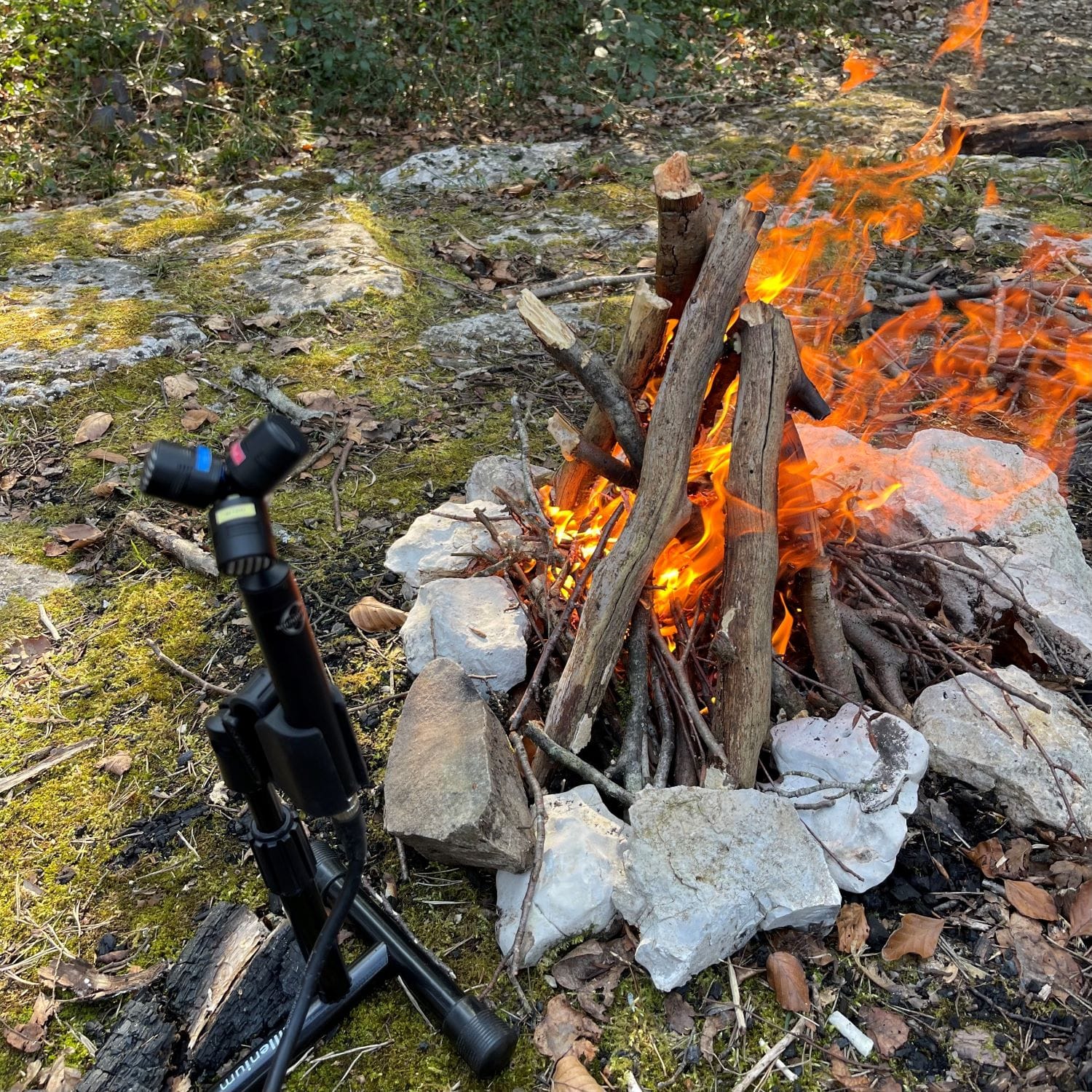
In this post, I’ll give a brief insight into the technique behind Sonora’s immersive soundscapes.
One microphone, the whole sound field
For our field recordings, I use the Soundfield SPS200 microphone. The key advantage of this microphone is its ability to accurately capture not only the sound itself but also its spatial dimension. This is achieved using a recording technique called First-Order Ambisonics. Instead of a simple stereo image (left/right), the SPS200 records a complete 360-degree soundfield. This means the direction of the sound source is preserved. Especially with nature sounds, which often have a very diffuse sound field, the difference is clearly audible even to the untrained ear.
From raw ambisonics to your headphones
However, the real work often begins after the recording. The raw Ambisonics data must be carefully processed in a procedure involving encoding and decoding. During this process, the 360-degree soundfield is converted in a way that creates an immersive, three-dimensional soundscape when listened to with headphones. This acoustically places the listener directly at the location of the recording.
The goal of this effort is to create a soundscape that is as authentic and spatially accurate as possible. This high fidelity is crucial for the nature sounds in the Sonora sound library to unfold their full effect — whether for concentration, relaxation, or as a sleep aid.
If you want the wider picture — equipment, editing practice, and how the listening research works — it’s documented on How we record and measure. And if you’re curious why the same soundscape every night matters, read Train your brain to fall asleep faster.